Tuesday, February 13, 2024

 Just wanted to take a second and share some new blurbs by three presidential historians that I admire. They were kind enough to write these up for my new book Lincoln’s Ghost.

“Even a president as down to earth as Harry Truman sometimes wondered if the White House was haunted. Is it? In Lincoln’s Ghost, Robert Buccellato goes searching for the answer. Along the way he brings to life the many strange, weird, and paranormal things our commanders in chief and their families have encountered. Combining rigorous history with ghost stories, Lincoln’s Ghost is at turns humorous and, yes, haunting. It’s thoroughly enjoyable, but it might make you want to sleep with the lights on!”


Matthew Algeo, Author of Harry Truman’s Excellent Adventure


“Robert Buccellato writes a mean, coolly, deliberate, and pointed prose, bringing to life ghosts long past. A great, informative, and (dare I say it) haunting book!”


- Jim Yoakum, author of The Bloviator: Sex, Drugs, Fraud, Suicide, Murder, Scandal, Adultery, Quackery, Corruption, Superstition and President Warren G. Harding.


“Lincoln’s Ghost” is a whimsical book full of Presidential ghost stories and lore from the creative mind of Robert Buccellato — the remarkable gentleman who brought you “Rumrunners and Moonshiners of Old Florida” and “Jimmy Carter in Plains: The Presidential Hometown.” Buccellato’s love of American History and natural ability for storytelling shines in this compelling compilation of spooky tales with mysterious ties to our American First Families and the haunted afterlife. It’s the perfect mix of fiction, speculation and campfire style ghost stories for anyone with an interest in our past Presidents.”

Andrew Och — The First Ladies Man — Author of “Unusual for their Time: On the Road with America’s First Ladies” VOL1&2


Lincoln’s Ghost is a new book that recounts all the humorous and odd history of White House/ Presidential ghosts and myths.

Monday, November 23, 2015

Radio Interview from the Chris Hahn Radio show

Based out of New York, the Chris Hahn Radio show is one of the leading Progressive news programs in the nation.
Here is a link to the interview which starts at minute 52

http://christopherhahn.com/


New Book Cover for Jimmy Carter in Plains The Presidential Hometown

The book is now available for Pre-Order on  Amazon, Barnes and Noble, and Books A million
Videos with images from the book are also on youtube 

Friday, November 20, 2015

Robert Buccellato Jimmy Carter In Plains Author Events


Robert Buccellato's Upcoming Events
Date City, State Venue Event

Feb 1, 2016
7:00 PM Atlanta, GA Jimmy Carter Presidential Library Robert Buccellato "Jimmy Carter in Plains, A Presidential Hometown" Lecture/Book Signing Monday, ...

Feb 2, 2016
10:25 AM Fremont, NE Back Porch Writer Author interview with Backporchwriter.com radio blog show

Feb 4, 2016
6:00 PM Ronkonkoma, NEW YORK Christoper Hahn Radio Show author book interview on new book Jimmy Carter in Plains

Feb 13, 2016
3:00 PM Americus, Georgia Bittersweet Author Book signing and presentation TIMES SUBJECT TO CHANGE

Feb 14, 2016
2:00 PM Plains, Georgia Jimmy Carter National Historic Site Book Presentation and Signing at the Plains High School

Lillian Carter A Compassionate life book Review

My book review of this great book by  Grant Hayter-Menzies

To call this book masterful would not be an overstatement. Grant Hayter – Menzies has done something near impossible, he has managed to remind a nation about one of its own neglected treasures. “Lillian Carter A compassionate life” starts off with a lovingly written foreword by Former President Jimmy Carter, the subject’s first born son. Many people reading this may instantly get images that this foreword in nothing more than a few quickly written sentences. This is not the case, and showcases President’s deep love for his deceased mother.

Menzies’ writing is nuanced and breezy. His visuals are compelling and revealing. The town of Plains and the backdrop of poverty stricken India are presented with haunting clarity. Lillian Carter is a detailed and fully formed human being in this biography and Menzies’ has managed to display the Carter family with all it’s great strengths and complexities. This was a literary experience that any fan of American History should undertake with great speed, an experience that I didn’t want to end.
-Robert Buccellato

Tuesday, November 17, 2015

Jimmy Carter in Plains Book Endorsement by Kevin Mattson

I am very honored to present the book endorsement made by author Kevin Mattson, the author of several exceptional books including "What the heck are you up to Mr President" and "Just Plain Dick."

"This marvelous little book shines light on the truly populist campaign that landed Jimmy Carter in the White House.  You can actually SEE the authentic and regular-guy style of Jimmy Carter at work.  The images of Carter's small-town background are especially compelling.  Political and historical junkies will find this book a great piece of entertainment that doesn't discount the moral and visionary heft that Jimmy Carter brought to Washington, D.C."
-Kevin Mattson, Author of "What the heck are you up to Mr President."

Thursday, November 12, 2015

"Jimmy Carter in Plains, A Presidential Hometown" book signing

author Robert Buccellato will be signing books at the Jimmy Carter Presidential library
Lecture/Book Signing
Monday, February 1, 2016 at 7:00pm
Carter Presidential Library & Museum Theater
Free and Open to the Public

Jimmy Carter In Plains Book Endorsement by Grant Hayter Menzies

Endorsement for Jimmy Carter in Plains: The Presidential Hometown

Though it may sound as if I'm stating the obvious when I say I wrote Lillian Carter: A Compassionate Life after falling in love with President Jimmy Carter's mother and all she stood for, that is only partly true.  I also fell in love with Plains, Georgia, the little Sumter County town where her son would make history in 1976.

Miss Lillian herself loved Plains with a depth and breadth even she, no stranger to eloquence, was unable to fully define.  As I wrote in my book, Lillian loved not just "the straight-backed pines, the snowy dollops of cotton and the little russet hills of turned peanuts; the pink and purple sunsets and the way night falls impenetrably dark as dreamless sleep", but also something else: "a special, unique something which flows through Plains like a slow, silent southern river, a quiet music you can never hear if you're just passing through."  It was the place where she, who had traveled the world, would rather be, she said, than anywhere else in the world.  I, who have traveled the world, didn't understand this till I went there myself.

When I picked up Robert Buccatello's gloriously illustrated new book, Jimmy Carter in Plains: The Presidential Hometown, I fell in love with the town all over again.  Of course, the history of the Carter family permeates the place.  It's a history reaching back almost two centuries, encompassing land grants and plantations and slaves as well as President Carter's Depression-era childhood as soon of a woman who, in her words, refused to recognize a color line, whose compassionate care for black families in the area helped build the character and compassion of our 39th president and global humanitarian.  But Plains, as described above, has its own special, unique something.  And you have to be there to understand, and to fall in love with it yourself.

Plains has served as crucible for both past and future; and where the two have collided, the future tends to win.  Yet the best of the past remains: the charming simplicity, the neighborliness of a kinder, more trusting era, and that bracing air of compassion for the less fortunate--those hungering in spirit as much as in body--the afterglow of which Miss Lillian left behind and which Mr. Jimmy continues to tend for all who will partake.  There is a magic in Plains you will not only scarcely believe when you go there to experience it, but a magic you will wonder you took so long to embrace, and I would urge you to do so whenever you can.  Before you do, though, get yourself a copy of Robert Buccatello's book.  It is a moving map to the heart of the town that made Jimmy Carter.  It is also a map to a place that will win your heart for good, and for the goodness that is Jimmy Carter's Plains.

Grant Hayter-Menzies

Tuesday, November 10, 2015

Jimmy Carter in Plains Book Endorsement - by Betty Pope

How do you capture a magical time in your life? This book of photographs and descriptions are evidence of Jimmy Carter's hometown and campaign for President of our USA.  Your book gives a true feeling of Plains, then and now.  People can experience the small town life and "down to earth" people who brought forth a awesome welcome to visitors then , now and forever.

I really enjoyed the revisit to the past!  Unforgettable.

- Betty Pope Founding member of the Carter Peanut Brigade

Jimmy Carter in Plains Book Endorsement - by Max J. Skidmore

Visual representations of politics in America are too often ephemeral,
taking the form of campaign literature that quickly vanishes, or news
reports that do not last beyond the headlines. Robert Buccellato, in what
obviously was a labor of love, has produced something different. His
presentation in pictures of the political life of President Carter before
and during his presidency should be welcomed by general readers who are
interested American presidents. Perhaps more important, these pictures
offer unique insights, making this book a contribution to American Studies
and to presidential history.

Max J. Skidmore
Author of After the White House: Former Presidents as Private Citizens

Tuesday, October 13, 2015

Jimmy Carter In plains the presidential hometown


a tribute video to Plains Georgia and their favorite son Jimmy Carter. Made in honor of the new book coming out from Arcadia Publishing "Jimmy Carter In Plains The Presidential Hometown." Written by Robert Buccellato with photos from Eddie Hunter and Charles Plant.

Wednesday, August 26, 2015

friends at last - The Carter/Ford friendship

It took a long time for these two men to become friends, but over the course of the thirty years between election night 1976 and Gerald Ford's passing, the former presidents became very close. This is evident in Jimmy Carter's eulogy of his predecessor, he had been asked personal by Ford to deliver his eulogy a short time before his passing, with Carter replying "Only if you promise to deliver mine."


It began with and ended with the now much quoted first line of Carter's inaugural speech in 1977, " For myself and for my nation, I want to thank my predecessor for all he has done to heal our land".  In a time period when Bush 43's presidency was nearly universally disliked due to it's handling of the aftermath of hurricane Katrina, and partisan tenses starting to flair up as a result of both a recent wave election that gave the Democratic Party control of both houses of congress and the sudden early start of the 2008 presidential election with John Edwards announcement in New Orleans on Dec. 28, 2006. It was both heart warming and comforting to see just how well the
nation's former presidents had been behaving with one another, which was on full display as Jimmy Carter spend much of the eulogy fighting back tears for much of his time at the alter( It should also be noted that at this time both George H.W. Bush and Bill Clinton were traveling around the country for Katrina relief and around the world for the tsunami relief which was much lauded at the time).


Who would have watched the debates between the two men and thought for one moment that they ever would have been anything more then civil or respectful to one another.  But, in the 30 years after the 1976 election, the democratic and Republican parties candidates had become so close, that during the white house's 200th anniversary dinner party, historians told carter and ford that there friendship was the closest of any former modern day presidents. It didn't happen over night, even with the respect Carter gave to Ford and his advice during his term of office. Every month then President Carter would send his national security advisor to Ford's home in Rancho Mirage, California and brief him.  The Briefing were filled with as much information as possible and were exceedingly more detailed than the Briefing Carter would receive under the Reagan administration, wish he received only after insisting on it.

That great show of respect Carter showed Former president and Ford's support for the New administration's controversial Panama Canal Treaty did much to help calm things down between them. But it wasn't until 1981 on a trip to Cairo where Ford, Carter and President Nixon represented the country for the state funeral on Egyptian President Anwar Sadat, that the two finally started to bridge the gap.  The subject that started it all was funding for Carter's Presidential library. Shortly after his defeat in the 1980 election, Carter told the White House Press Corp that he wouldn't use his fame as a president to any form of commercial benefit. Four Years early Gerald Ford had made many lucrative deals with fortune 500 companies to sit on the boards and speech for them across the country.  But Carter wanted to take a leaf from his ideal Harry S.  Truman and deal with the burdensome task of finding the financing for his library some other way.  The Presidential library would have to house nearly 25 million official documents, photos, papers, and mountains of film and other mementos, and with Carter having the image of a failed president the millions he would need to raise was going to be both a humiliating and argued to say the least.

Ford was already an expert in the area and was more then welling to help Carter with information from putting together a staff, mission statement, and future fundraising.
Once the Carter Center was built the two presidents traveled back and forth between their libraries and gave symposiums on each other's presidency. In time Ford would help Carter on several Goodwill trips for The Carter center from conferences with congressional leaders on peace in the middle east to Nuclear arms control talks at Emory University. There were moments during the Clinton Administration were the friendship waned a bit. Mainly due to Ford feeling that Carter was getting too involved with the North Korean Peace Talks and felt he was undermining Clinton's foreign policy. But such claims about Carter's Diplomatic efforts on behalf of the Carter Center have been made by other presidents as well, not just Ford. The Bushes in particular never got along with the Georgian Democrat, and Carter spoke more openly against the Bush 43 presidency then any other political figure.

But around 2000 a funny thing started to take shape in Gerald Ford. He had for years grown ever uncomfortable about the more of his party towards the extreme right. He hated attending the National Convention in 1992 when Pat Buchanan made comments like "lets take back our country" as if in Ford's mind they were making the claim that it was un-american to be a Democrat. He still deeply regretted giving into the demands of the party's right in 1975 and dropping Rockafeller from the ticket. And he still felt that Ronald Reagan's Primary Challenge had damaged 1976 campaign severely maybe even fatally. And he broke with conservative members of the Republican party in October 2001, by stating that gay and lesbian couples "ought to be treated equally. Period.". This comment made him still the highest ranking Member of the GOP to embrace equal rights for Homosexuals and lesbians. He also would also become a member of the Republican Unity Coalition and group of well known Republicans who's sole mission was to broaden the party's tent and make Gay rights a non issue
He would even state in several interviews released after his death that he was both pro choice and disagreed strongly with the Bush Administration's policy in Iraq. Calling the war a big mistake and claiming that it was never justified. Saying that his former chief of staff now turned Vice president Dick Cheney and then Defense Secretary Donald H. Rumsfeld, who served also as Ford's chief of staff and then his Pentagon chief had along with Bush 43 made a big mistake in putting the emphasis on weapons of mass destruction and never publicly saying they were wrong. He even claimed that both Bush 41 and Barabara Bush had been like Ford and his wife Pro choice for years. Something that he said they had privately told him and that Bush would later disclaim in the Newsweek issue realized after Ford's passing.

So both former presidents could be outspoken critics, each in there own ways and in there own time, and they were far from always at an agreement with one another.
But at the end of the day they were close friends bound together by love of country and their service to it. Betty and Rosylann were very close to one another and the families got along great as well. Carter was always a hard man for some people to befriend, but Ford wasn't and his easy nature won over in the long run.  In many ways their differences in personality counter balanced one another. Ford was a drinker, smoker, deal maker, Midwestern, all american main street, clumsy athlete. Carter was a one drink at dinner parties, beer after church, hard working, non smoking, nuclear scientist, baptist, southern born know it all.  Together they made up a marvelous kaleidoscope of Americana.

The two former presidents co-authored a 1983 Reader's Digest article criticizing Israel, a 1988 governing blueprint for President George H.W. Bush and a 1998 New York Times op-ed piece urging Congress to censure former President Bill Clinton. They lobbied for the North American Free Trade Agreement in 1993 and against initiatives in 1996 to legalize drugs in Arizona and California.

They had both also come along way in how the public persevered them. Ford went from a historical footnote and SNL punching bag to an elder statesmen and recipient of  the medal of freedom. It was during the award's reception in the east room in 1999, that President Clinton said what many in the democratic party had being saying for years, that Ford was "right about pardoning Nixon and that he (Clinton then a candidate for congress in 1974)was wrong". History had by that time been very good to our 38th president and had come to see his pardoning Nixon as a selfless act of political courage and foresight.

Carter had gonna from the image of a weak failure, to the most powerful and positive force for peace in the world.  His post presidency poll numbers  had risen sharply over the years and he had been rewarded more then any other former president for his humanitarian and peace keeping efforts.  Every kind of honor and accolade you can imagion he had received, from the medal of freedom to the Albert Schweitzer Prize. From the Liberty medal to nearly twenty honorary scholarships. Then in 2003 Jimmy Carter became the first former us president to receive the Nobel Peace Prize.
The following year he would give a keynote speech against both the Iraq War and the re-election of George W. Bush. This was a striking contrast to how he was treated for years within the Democratic party,even ignored by some. In 1992 when comparisons were made between Clinton and Carter, Clinton went out of his way to distance himself from the political weak former president. Now like Ford, everyone was clamoring for face time with the Nobel laureate.

The two would continue to make speeches and public appearances, mainly at one another's libraries or at the state funeral of Ronald Reagan. But in 2005, at 91 doctor's orders had began to limit ford's travel. Carter was forced to attend the opening of the Clinton library without his usual limo partner. Ford was also invited too, but did not attend the second inaugural of Bush 43. And when both Carter and Ford did not attend the funeral of John Paul II in the summer of 2005, it seemed to only compound the image that Carter had a distant relationship with the two other former presidents and the current president(all three of whom did go) and the notion that Ford was in fact ailing.

By the early 2006 Ford's health was on the decline. In early January he was hospitalized at Eisenhower Medical Center near his home in Rancho Mirage for pneumonia and was released till the following week. In mid-December of the following year, Ford underwent routine tests at Eisenhower and was hospitalized overnight because of a chest cold.
President Bush payed Ford and Betty a visit to there California home on the 23rd of April. Holding a cain and visibly weak and pale, but with a smile on his face, he made his last known public appearance along side the president. Wearing a socked in yellow shirt and holding onto Bush 43's hand, he addressed questions to the press and posed for pictures out in front of his house on his driveway. In July Ford was admitted at Vail Valley Medical Center for shortness of breath. Ford had celebrated his birthday (his 93rd) there in Vail on July 14 and Betty was hoping that they would spend the summer there. Once he was realized the ford family enjoyed the former president's final summer together till he was admitted to St. Mary's Hospital of the Mayo Clinic in Rochester, Minnesota, for testing and evaluation on the 15th of August. It was then reported on August 21st that he had been fitted with a pacemaker. Four days later President Ford underwent  an angioplasty procedure at the Mayo Clinic.

On November 12, 2006, upon surpassing Ronald Reagan's lifespan, Ford released his last public statement:
The length of one's days matters less than the love of one's family and friends. I thank God for the gift of every sunrise and, even more, for all the years He has blessed me with Betty and the children; with our extended family and the friends of a lifetime. That includes countless Americans who, in recent months, have remembered me in their prayers. Your kindness touches me deeply. May God bless you all and may God bless America.

This short and humble statement would be the last one the former president would ever release to the press.

It was around that time in November 2006 that Jimmy Carter was getting ready for the release of his new book "Palestine: Peace Not Apartheid" and the title alone was creating a firestorm of controversy. Carter had always had a very difficult relationship with the american Jewish community and now the new book was being preconceived as something of an admission of his lifelong antisemitism That he was speaking in favor of Palestine and terrorist movements within the holy land. This was in fact not true, and even though Carter has always been supportive of a Palestine state and friendly towards Arab leaders. He has always been a friend of Israel and desired peace in the holy land.  Yet his book frankly spokes out against Israel's policies toward Palestine as being in his eyes a system of apartheid.  All throughout the winter of 2006 and fall of 2007 carter would be on his national book tour promoting the book. At every city Jewish leaders would confront Carter, in Arizona a protest of several hundred lined the book store while Carter was inside signing copies. At another book signing a woman told he needed to be tried for treason.  Brandeis University invited Carter to debate Alan Dershowitz on the merits of the book. There were claims from other authors that Carter had plagiarized material and maps from their books and used them as un-cited support material in his own. Other critics simply just called Carter a liar and one Carter center fellow even resigned.

Filmmaker Jonathan Demme followed Carter during his national book tour promoting the book, and it would eventually be the 2007 documentary "Man from Plains".  But during the middle of the film there is a gap between filming from December 2006 and early January 2007. This was unfortunately due to the death and then state funeral of Gerald R. Ford.

Ford died at the age of 93 on Dec. 26 at his home in Rancho Mirage. He had been sinking fast and his finally Christmas had been spent bedridden except when the family priest arrived a day or so earlier for Christmas mass. The former president was then removed from his bed, dressed and taken to the living room in a wheelchair for the private service. He had been failing for some time and it was to no one's surprise when he passed on, but everyone was saddened by it. Former first lady Betty Ford and the ford family released a statement following his death,


"My family joins me in sharing the difficult news that Gerald Ford, our beloved husband, father, grandfather and great grandfather has passed away at 93 years of age. His life was filled with love of God, his family and his country."

Moments later CNN confirmed his passing and President Bush released a statement from the White House speaking like every other statement released by the former presidents, u.s. senator, governors, congressmen, and news outlets in the days following his death. Speaking about a nation's loss and a man's service.

The body of former was flown to Washington D.C. and In keeping with Mr. Ford's wishes to keep his funeral simple, there was no horse-drawn caisson, no riderless horse, no procession but a motorcade. His Service was nearly half the length of Ronald Reagan's from two years earlier.

The state funeral began with a service at Washington National Cathedral, then moved to Grand Rapids for Ford's final homecoming. The marching band from the University of Michigan, the school where he played football, greeted the White House jet carrying his casket, members of his family and others in the funeral party. The service in Washington unfolded in the spirit of one of its musical selections — "Fanfare for the Common Man". The song was followed by a eulogy from Bush 41 who, called Ford a "Norman Rockwell painting come to life" and then made jokes about Ford and his sometimes very erratic golfing. President Bush escorted his widow, Betty Ford, down the aisle of the great stone cathedral, past nearly 3, 000 mourners. Tom Brokaw was the next to eulogize Ford. Followed by Henry Kissinger and then finally Jimmy Carter.

Following the funeral Carter engaged Secretary of State Rice in an animated conversation while waiting for the funeral party. Rice also chatted with Chelsea Clinton, daughter of Bill and Hillary Clinton, and at one point the three ex-presidents shook hands.

The body of former President Gerald R. Ford has spent the past two days before lying in state in the capital rotunda, while thousands of visitors came by to pay there last respects and given funeral cards by capital staffers. At one Point a chair was placed in the middle of the giant room and from a corridor soon emerged Betty ford. She sat down on the chair with her family behind her and just stared at the flag draped coffin.

After the funeral service in Washington the body was taken to the grounds of the Ford Museum in Grand Rapids where it was finally laid to rest. While the body was in transit between Washington and Michigan, two figures gathered with the ford family in the cabin of Air force one, Jimmy and Rosalyn Carter. It was the last leg of a brilliant american political story and the final destination of a touching and sincere friendship between two former opponents that began 30 years prior. When
a nation celebrated it's bicentenary and a one term governor challenged an accidental  incumbent president.


solving social security

There are many ways to fix this program so that many will benefit from the positive aspects of it's overall coverage. These solutions, like the problems that have forced them to slowly be required tend to be very easy. It is merely the political will or lack there of that forces this issue to become the third rail of American politics. Will actually it's the third rail of Democratic Politics, it's fifty pounds of red meat to say "First thing I'll do it cut social security and give you your money back" in Republican primaries.  One possible solution is a revenue increase rather than a reduction of benefits.  Also an increase in the age of retirees receiving social security would not be totally outside of the realm of possibilities in the near future. BabyBoomers after all live longer than their parents and the life expectancy of both generation X and the echo generation is projected to be even longer.
According to the fix social security game, an increase of taxs on the top earners and the removal of the salary cap, would actually solve many of the program's current problems.  But, the game also warns the viewer that even then the program will need to be fine tuned. This can prove to be fighting words to generation of policy makers hows only ways of dealings with a problem in a entitlement program is to either either hid under the covers or look towards destruction of  that program as the only possible solution.
At this moment for example the congress is fighting over the long term assisted care insurance act. All day long they have argued over the class Act and have come up with one of two solutions.
1. leave it alone because, it can not be currently fixed given the current political climate, and because it is still financially secure (it will be till 2032).
 2. try and repeal it because it is a part of  "ObamaCare" and will be a moral victory to a congressional majority with an approval rating of minus 47.
The facts are these, a gradual increase of the retirement age for those born after 2024, would improve social security. Progressive indexing of taxs to reduce benefits of those that make over two million dollars a year or above would improve the system.  These will not be introduced to the floor of the U.S. house of representatives till rome burns to the ground.
There have ofcourse been those that wished to solve this completely solvable issue of our time.  President Bush 43 wanted to put benefits in PRA's back in 2005. It was based on the believe that by 2017 social security would start paying out more than it was taking in. (Social security reform center).  President Bush's idea would have been a wonderful way to fix social security, just as long as there would never be a recession and the housing market remained strong.
Even with the weak economy as it is, those that face issues such as long term care, and home healthcare aid, have managed to remain above water due to entitlement programs. (Kurtzeleben, 2011). The Census Bureau has reported that nearly 14 million seniors would be bankrupt if it were not for entitlements like social security,medicare, and medicaid. (Kurtzelben,2011). This seems pretty understandable when you the average retirement house cost about 17 thousand dollars a year.
The constitution calls for provisions to be made to protect the common welfare. It is not a ponzi scheme, but a support system for unforseen costs of living concerns. The solutions mentioned above can close the social security gaps. By closing the Payroll cap, it would mean a few paying more some the same benefits as all of us, but it would mean that one indidvual who makes 200,000 dollars a year for twenty years could pay a bit more. So that 200,000 people that make 37 thousand dollars a year can benefit from social security.
Even the Heritage Foundation's flat social security plan has cuts in benefits for those that are in the top 9 percent. (Savingthedream.org). It also calls for a 401k style of supplement plan, which does nothing to stop people currently retired from cashing it out as of the close of business yesterday. But, it seems like a good idea for future retirees. It it goes along with a reformed version of Social security and doesn't slowly substitute the program as a whole(Savingthedream.org).
According to NPR.org all solutions of fixing social security come down to three options. 1. more tax revenue, 2. Less benefits, 3. a mix of both. Sociological ideals back up taxes on the top earners. That social security now serving as a life blood to so many retired Americans, it seems only natural for the program to be saved due to the efforts of those that don't really need it.  It alone takes political will to actively solve this tragically solvable issue.


Resources
1. Social Security Reform Center.
Retrieved from : http://socialsecurityreform.org/fastfacts/index.cfm
2. Kurtzelben, Danielle. ( September 15, 2011). "5 Ways to Reform Social Security"
Retrieved from : http://www.usnews.com/news/articles/2011/09/15/5-ways-to-reform-social-security
3. Heritage Foundation "Saving the Dream"
Retrieved from : http://savingthedream.org/what-it-covers/social-security/
4. Horsley, Scott. (June 5, 2009). " Fixing Social Security: A Solvable Problem"
Retrieved from : http://www.npr.org/templates/story/story.php?storyId=104958835
5. Hart-Landsberg, Martin. ( August 11, 2011). "SOCIAL SECURITY IS IN DANGER"
Retrieved from : http://thesocietypages.org/socimages/2011/08/11/social-security-is-in-danger/


Tuesday, August 25, 2015

Jimmy Carter Historic Site

The following post is a shared re-post of the Jimmy Carter Historic Site's two very interesting notifications from their facebook page hope you like it

 In 1928, Earl Carter moved his family from their home in downtown Plains to this farm in Archery, GA. Here, on these 360 acres, a young Jimmy Carter learned the value of honesty, hard work, patience, diligence, and so much more. He developed an appreciation for the natural world, being fascinated by the science and beauty of his surroundings. He developed lasting relationships with the community as well as the land, and developed a strong sense of self. It was on this property that he learned the peanut business, engaged in his favorite hobby of reading, came face-to-face with the difficulties of segregation, developed his dreams and future goals, and so much more. The importance of this rural farm to the development of America’s 39th President is unprecedented and evident by his frequent visits to the site.

I have always loved the former president's bedroom and how he must of dreamed of a life in the navy.
 This commemorative T-shirt, owned by Plains resident and Peanut Brigader Ida English. This shirt and other souvenirs were proudly displayed by Jimmy Carter’s supporters to celebrate his victory in the 1976 presidential election. This style of shirt was worn by Peanut Brigaders on the night of Jimmy Carter's Presidential election. It was the idea of Maxime Reese to have these t shirts made and it wasn't until Jimmy Carter won late in the early morning that those on the platform reveled the t shirts.

Monday, August 24, 2015

Jimmy Carter Profile 1976


After two terms in the state senate and one failed attempt, Carter would win the Governorship of Georgia in 1970 following a four year campaign effort that began immediately after his 1966 defeat. His success on this second campaign was largely due to his efforts to win over conservative Democrats and portraying himself as a common peanut farmer. Billy Carter had been in charge of the family business for the past six years, since Jimmy’s election to the governorship. He also purchased the local service station from owner, Mill Jennings. It would become a popular gathering place for the national press and local barbecues. It was also the first place local wives came to look for their husbands after work. During the first three months of the campaign, the entire Carter family which included his wife Rosalynn, their three sons, their wives, and Carter’s mother and siblings, traveled to forty different states, cultivating and nurturing support among the state’s press, unions, and party structure. In these early days, it was not uncommon for a potential Carter supporter to be showered by personal phone calls and hand written letters from both Carters. On December 12th 1974, Jimmy Carter officially declared his candidacy for the presidency. The determination of this one man and the devoted support of his hometown didn’t seem to sway many people early on. “Jimmy is running for what?” was a popular headline in the Atlanta Constitution and he is still the only modern president whose announcement wasn’t preserved on film for posterity. This was due to the conviction by many that he would never win. 


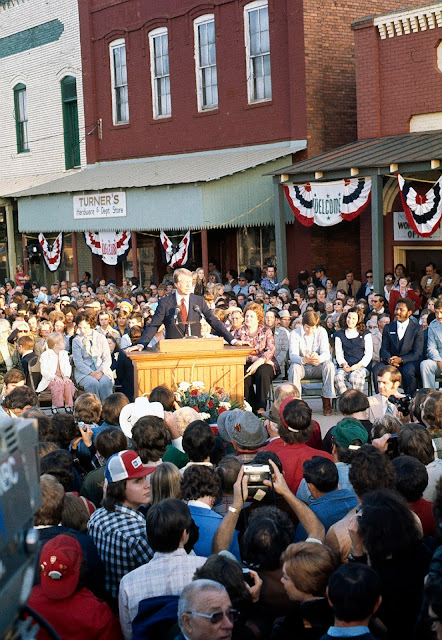
As the Carter presidency began to look like a serious possibility, the town’s fathers started to think hard about the community’s future. Even in the fall of 1976, there was talk of turning much of the town into a national park. While some of the more ambitious schemes and plots unraveled, the idea of preserving key structures of the town as a park continued to flourish. The start of Carter’s campaign was marked by loneliness. No reporters followed him as he made the sometimes embarrassing journey across Iowa and New Hampshire asking for votes. With a stack of green and white brochures in hand, Carter stopped people on the street and said with a smile, “Hello, my name is Jimmy Carter and I’m going to be your next president.”One resident remembered it as “waking up to find your home in the middle of a world’s fair.” Before, it wasn’t uncommon to see local women turning up at the business district of the town in curls or without makeup. After the frequent and prolonged national exposure the town was receiving, they wouldn’t dare step foot there without full makeup and hair, because they would most likely end up on the evening news.