How do you capture a magical time in your life? This book of photographs and descriptions are evidence of Jimmy Carter's hometown and campaign for President of our USA. Your book gives a true feeling of Plains, then and now. People can experience the small town life and "down to earth" people who brought forth a awesome welcome to visitors then , now and forever.
I really enjoyed the revisit to the past! Unforgettable.
- Betty Pope Founding member of the Carter Peanut Brigade
Showing posts with label train depot. Show all posts
Showing posts with label train depot. Show all posts
Tuesday, November 10, 2015

Jimmy Carter in Plains Book Endorsement - by Max J. Skidmore
Visual representations of politics in America are too often ephemeral,
taking the form of campaign literature that quickly vanishes, or news
reports that do not last beyond the headlines. Robert Buccellato, in what
obviously was a labor of love, has produced something different. His
presentation in pictures of the political life of President Carter before
and during his presidency should be welcomed by general readers who are
interested American presidents. Perhaps more important, these pictures
offer unique insights, making this book a contribution to American Studies
and to presidential history.
Max J. Skidmore
Author of After the White House: Former Presidents as Private Citizens
taking the form of campaign literature that quickly vanishes, or news
reports that do not last beyond the headlines. Robert Buccellato, in what
obviously was a labor of love, has produced something different. His
presentation in pictures of the political life of President Carter before
and during his presidency should be welcomed by general readers who are
interested American presidents. Perhaps more important, these pictures
offer unique insights, making this book a contribution to American Studies
and to presidential history.
Max J. Skidmore
Author of After the White House: Former Presidents as Private Citizens
Tuesday, August 25, 2015
Jimmy Carter Historic Site
The following post is a shared re-post of the Jimmy Carter Historic Site's two very interesting notifications from their facebook page hope you like it

In 1928, Earl Carter moved his family from their home in downtown Plains to this farm in Archery, GA. Here, on these 360 acres, a young Jimmy Carter learned the value of honesty, hard work, patience, diligence, and so much more. He developed an appreciation for the natural world, being fascinated by the science and beauty of his surroundings. He developed lasting relationships with the community as well as the land, and developed a strong sense of self. It was on this property that he learned the peanut business, engaged in his favorite hobby of reading, came face-to-face with the difficulties of segregation, developed his dreams and future goals, and so much more. The importance of this rural farm to the development of America’s 39th President is unprecedented and evident by his frequent visits to the site.

I have always loved the former president's bedroom and how he must of dreamed of a life in the navy.
 This commemorative T-shirt, owned by Plains resident and Peanut Brigader Ida English. This shirt and other souvenirs were proudly displayed by Jimmy Carter’s supporters to celebrate his victory in the 1976 presidential election. This style of shirt was worn by Peanut Brigaders on the night of Jimmy Carter's Presidential election. It was the idea of Maxime Reese to have these t shirts made and it wasn't until Jimmy Carter won late in the early morning that those on the platform reveled the t shirts.


I have always loved the former president's bedroom and how he must of dreamed of a life in the navy.

Monday, August 24, 2015
Jimmy Carter Profile 1976

After two terms in the state senate and one failed attempt, Carter would win the Governorship of Georgia in 1970 following a four year campaign effort that began immediately after his 1966 defeat. His success on this second campaign was largely due to his efforts to win over conservative Democrats and portraying himself as a common peanut farmer. Billy Carter had been in charge of the family business for the past six years, since Jimmy’s election to the governorship. He also purchased the local service station from owner, Mill Jennings. It would become a popular gathering place for the national press and local barbecues. It was also the first place local wives came to look for their husbands after work. During the first three months of the campaign, the entire Carter family which included his wife Rosalynn, their three sons, their wives, and Carter’s mother and siblings, traveled to forty different states, cultivating and nurturing support among the state’s press, unions, and party structure. In these early days, it was not uncommon for a potential Carter supporter to be showered by personal phone calls and hand written letters from both Carters. On December 12th 1974, Jimmy Carter officially declared his candidacy for the presidency. The determination of this one man and the devoted support of his hometown didn’t seem to sway many people early on. “Jimmy is running for what?” was a popular headline in the Atlanta Constitution and he is still the only modern president whose announcement wasn’t preserved on film for posterity. This was due to the conviction by many that he would never win.
As the Carter presidency began to look like a serious possibility, the town’s fathers started to think hard about the community’s future. Even in the fall of 1976, there was talk of turning much of the town into a national park. While some of the more ambitious schemes and plots unraveled, the idea of preserving key structures of the town as a park continued to flourish. The start of Carter’s campaign was marked by loneliness. No reporters followed him as he made the sometimes embarrassing journey across Iowa and New Hampshire asking for votes. With a stack of green and white brochures in hand, Carter stopped people on the street and said with a smile, “Hello, my name is Jimmy Carter and I’m going to be your next president.”One resident remembered it as “waking up to find your home in the middle of a world’s fair.” Before, it wasn’t uncommon to see local women turning up at the business district of the town in curls or without makeup. After the frequent and prolonged national exposure the town was receiving, they wouldn’t dare step foot there without full makeup and hair, because they would most likely end up on the evening news.

President Jimmy Carter tribute video
A short tribute video i made about Plains Georgia and their favorite son Jimmy Carter. Made in honor of the new book coming out from Arcadia Publishing "Jimmy Carter In Plains The Presidential Hometown." Written by Robert Buccellato with photos from Eddie Hunter and Charles Plant.
Sunday, August 23, 2015
Jimmy Carter in Plains book - the train depot of plains
There is a historical pull to this place and it’s become manifested in the tiny green and white painted train depot at the center of town. For myself, this humble structure has always held such romantic attachment. This was where Jimmy Carter pulled it off. Where he, along with his neighbors and family staged the most improvable and captivating Presidential campaign in history, forever changing the political landscape of the nation and how we pick our presidential nominees.


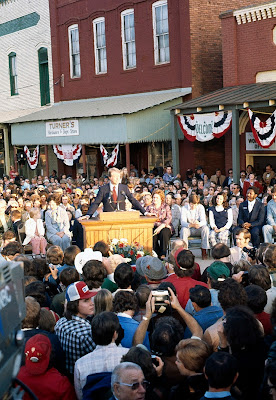

Once you enter the depot, long devoid of frequent activity, a single video can be heard echoing throughout the building. It is a video that Charles Plant put together on the 1976 election. The images are old and the voices heard are those that use to fill the television screens in countless homes decades earlier. The nightly news anchors of the past; Cronkite, Harry Reasoner, and John Chancellor, can be heard. The desired effect is easily achieved, transporting visitors back to a time when this depot was packed with locals and campaign workers and primary nights would turn into local vigils and tailgate festivals, as several TVs were installed to witness the results of so many past contests, when their favorite son was trying to achieve the impossible.
. Two rocking chairs, used frequently by America’s First Mother, Lillian Carter, can still be seen. Today, a sign proudly and humorously recounts the fact that “Behind this closed door” is the reason why the depot was selected as the campaign headquarters. It was the location of the only available public bathroom in town. Today the bathroom is closed and visitors are prevented from entering this historic lavatory.
As the election of Jimmy Carter became a real possibility, both the candidate and his hometown started becoming big business. Carter’s wide smile began showing up everywhere in town and souvenir makers had a field day turning the town into a household name nationwide. Some, like the N.G. Slater campaign buttons were of high quality, while others were simply made by an endless series of small entrepreneurs looking for an easy buck. Eventually, the massive level of outside guests began to die down. After the Carter Presidency entered the history books, the town and its famous son both shared in parallel struggles to acclimate themselves to life outside the national spotlight. Plains and Carter both took it upon themselves to help preserve the best elements of the 1976 election and its aftermath for posterity. It was not an easy task for them both. But, President Carter threw himself into the task of turning key structures of his hometown into a national park. With the aid of the residents and outside support, the former president succeeded beyond his wildest hopes.
The town’s train depot was constructed in 1888 and was, for a time, the only building with a public bathroom. This was the primary reason for its selection as the hometown headquarters for the Carter Presidential campaign. It was the site of numerous hometown primary parties and was where candidate Carter would hold interviews whenever in town. As the 1970s dawned, Plains remained largely unchanged. But, following his announcement for president, the entire landscape of the community began to change. The primary night parties would begin at the depot and quickly took on a church potluck atmosphere. There were said to have been rows of flatbed trucks everywhere and tiny campers.
This commemorative T-shirt, owned by Plains resident and Peanut Brigader Ida English. This shirt and other souvenirs were proudly displayed by Jimmy Carter’s supporters to celebrate his victory in the 1976 presidential election. This style of shirt was worn by Peanut Brigaders on the night of Jimmy Carter's Presidential election. It was the idea of Maxime Reese to have these t shirts made and it wasn't until Jimmy Carter won late in the early morning that those on the platform reveled the t shirts. Miss Lillian raised her tired self from her rocking chair on the Platform to reveal her shirt and suddenly fell down. Laughing she soon recovered and the crowd went wild.
The Town in a short period of time had gone from a sleepy community of 600 people into the capital of American political life. While the nation's major cities were spending millions each year to attract new residences to their communities. The town of Plains was getting up to 10 thousand tourists a day and hadn't spend a dime. But, of-course all of that was soon to change.
The inside of the train depot museum during the 1980s. Following 1979 the crowds in Plains began to die down and once Carter lost re-election the community began to turn sleepy once again. There was till tourists, but never like the glory days. Before the National Park Service became actively involved in preserving the town, the depot served as the town’s visitor center. Today it has interactive exhibits and detailed accounts of the 1976 election. But, when this picture was taken, the citizens of Plains relied almost solely on their own personal memorabilia to fill the museum.
The Jimmy Carter National Historic site and preservation district was established by an Act of Congress in 1987. The historic site consists of the railroad depot, shown here in the early 1980s, that had fallen into disrepair, the boyhood home, that needed to be purchased, and the Carter compound. The preservation district consists of the historic district and 650 acres of agricultural lands.
The Depot Museum was designed to retain all the humble charms of its 1970's structure and to also host a grouping of anecdotes from the 1976 election. In the beginning the town could only depend on the relics they themselves still had in their homes and in shops on Main Street. But, then Carter Presidential Collectors began to make very generous donations to the site and the place became one of the most appealing parts of the historic district.
Tuesday, November 12, 2013
Election night 1976 part 2


As the polls closed across the nation Carter began to work the phones. He called every democratic congressional candidate that lost their race that night. Jody Powell would later say it was to show that "someone had to remember the losers, even when everyone else was looking at the winners". He also called supporters to thank them for their service to his campaign. Mayor Daley of Chicago was called, the forecasts coming out of Illinois were mixed at best and Carter wanted a detailed reading on the state's progress. Daley was holding several vote tallies from several democratic strongholds around Chicago, as a backup in case Carter needed a late surge as the night wore on. In the end Daley's efforts were either noble or helpful, and Carter lost the state.
A shift was slowly taking place inside both the White house and the Omni Capital suite, the ford group began to seem like children growing tired of playing a game they kept losing, while the Carter group started to carry a kind of natural and systematic mental shift from cautious optimism to middle uncertainty. They were slowly running out of southern states and Ford's western Second wind was just moments away. Earlier in the evening the Carter aides were letting out cries of joy as the results were called over the television, but now both parties were now prepared for the predicted turn in the candidate's electoral fortunes.
For the first time ever in the history of Televised presidential elections, the results of both the national totals and the state by state count was not placed on giant hand drawn boards. They would instead be projected up on the screen complete with an image of the state and photos of the two major party candidates. The box that would rest beside the anchor would also be complete with the vote total currently in and the projected winner of the state at that given moment.
Each network had their own format and each had it's own system of election analysis hard at work behind the scenes looking over all raw statistical data and projections as it was being handed to them. They all followed roughly the same method of deciding a projected winner. NBC followed two tracking polls, one that was from major precincts from every state that showed a rough but summed up total of a statewide vote, the other covered trends in the voting and was complete with on the ground updates provided by each state.
CBS had three different teams of Statisticians going over the raw election returns from across the country and promptly broke the information into voter categories like age group and race. Turning the data into simple talking points for the on camera talent.
ABC had three decision desks with private computers that gave direct relays to the anchor team at the studio. All sample precinct data was provided to all the networks by the National Election Serivce. Every single member of all three teams had to be in total agreement before any kind of announcement or decision was brought to the anchor's desk.
28 percent of Americans were tuned into John Chancellor and David Brinkley, while ABC and it's team of election night headed by a young Barbara Walters garnered 18 percent of the public attention, while 26 percent choose to tune into either public broadcasting or local news channels for their coverage. But the person who received the biggest share of the audience that night was the most trusted journalist of his day and a man who would become sanomies with some of modern history's most important moments, Walter Cronkite captured 30 percent.
After the opening of election night coverage on all networks and the early calling of Kentucky for Carter and Indiana for Ford. The only other early states called for the President was Nebraska, Connecticut, and Dole's homestate of Kansas. After that a large rundown of states were called for Carter, from the east to nearly all of the south. From Massachusetts, and rhode island, to west virginia and tennessee. North Carolina was called for Carter as was his homestead of Georgia and it's electoral rich neighbor Florida. After that Georgia's left and right neighbors Alabama and South Carolina were also given to Governor Carter. Carter had a clear majority of the African American vote and his massive regional appeal in the south gave him a lock on every single state in the south safe for two that were still too close to call, the states of Virginia and Mississippi.
NBC created for the first time a giant electronic map of the United States that would as it turned out provide a odd imagery contrast from the election of 1976 to current elections was the color each party received when they won a certain state, In future elections the Republican won state would be drawn on the electrol map grid as Red and the Democrat won state would be a royal blue. In 1976 a state would little up as red if it was for Carter and Blue if it was for Ford. Thoughout the evening the president could be heard yelling "go Blue, Go Blue!", maybe the only and last time a Republican presidential candidate would pray for a state to turn Blue.
After the first southern and eastern states that went to Carter, the networks started to dramatically suggest a comeback for the president, that less then an hour later was turned into a political reality on it's electronic map. Every single state in the west turned blue for Ford. All of the Rocky Mountain states from Montana to Colorado and New Mexico. Most of what was leftover from Carter's early victories in the interior lowlands also want to Ford as did every state in the great plains region. Before long the only states now left on the table were the battleground states, the three states that makeup the west coast, and the northern industrial states that both candidates would have to earn a majority of to be named the night's winner.
The six northern states New York,New Jersey,Pennsylvania, Michigan,Illinois,and Ohio had a total of 158 electoral votes between them and roughly half 270 needed to earn a four to eight year stay at pennsyvania ave. They also along with Texas and Calfornia made up the big eight that both camps had calculationed into their strategists for victory. It was universially agreed at this point that Ford would have to win the lion's share of the big eight to pull off a come from behind Truman style victory.
Ford was solid in Calfornia, and even though it gets called late in the evening, would be a huge victory for the president. Texas was the south and Carter had captured that entire region's imagination, so Texas was all but laminated under Carter's column with the other deep south states from the get go. So Ford was going to have to win four of the six northern states. Michigan was his home state and it was called early for their favorite son, and the president's advisors felt pretty confident about their strength and ad buying ability in the midwestern states, so Illinois was going to be tough but would end up being a Ford Victory also. The President wasn't concerned with Mayor Daley seating on democratic strongholds, he knew that the Republicans were powerhouses in the southern Illinois and could withstand any late night Cartwer surge in voting.
New Jersey was going to be close too, and hard to read because media ad buy in New York from both camps was seeping into Jersey. In the end the president was able to pull off a new jersey win and capture it's 17 electoral college votes by a close 2 percent margin of victory. The race was always going to come down to Ohio and both candidates would need it's 25 electoral votes to win. In Fact on election eve the president and the first lady held their campaign's final rally there in Ohio before going to Michigan for the night. As it would later turn out Ford campaigned in the wrong areas of ohio. He campaigned hard in Columbus, and made a brief stopover at Cininnati. But Columbus provided to be a place that was already safely won by the president, while Cininnati and Cleveland were leaning hard towards Jimmy Carter. Had Ford campaigned in Cleveland the outcome of the election might had been different.
By midnight the networks had slowed down their returns, too many states were close and no one wanted to call anything without total certainty that it was going to it's proper winner. Then at around 12:05 CBS called Oregon for Carter, and then nearly three hours later a very embarrassed Walter Cronkite had to inform the viewing public that the state was being pulled back under the uncertain column. It would eventually go to ford, who won it be a margin of 0.17 percent over Carter.
Hamilton Jordan who had been completely confident at the beginning of the night was now looking at the map of called states and started to panic. He would later claim" When I saw the ten or twelve states that were out, it occurred to me that the thing could slip away from us." Ham Jordan wasn't just being a worried papa looking over the final uncertain moments of a national campaign, he did have good reason to get scared. The first results coming out of Hawaii were bad, and it was not out of the realm of possibility that all the states still undecided would go to the president.
The hotel room at the Omni was starting to get filled with guests. Martin Luther King Sr. was there as was Coretta King. Jordan and Carter went into the master bedroom to work the phones and look over the returns. Caddell was getting reports on the ground from across the country and would brief Carter from time to time. It was Caddell that first informed Carter that he would lose New Jersey and that New York was still a jig zag puzzle of a situation. Carter then personally phoned New York City Mayor Abraham Beame and was reassured by Beame that his big win in Manhattan would be enough to carry the state. Caddell then called Mayor Rizzo of Philadelphia who reported that Carter was 260,000 votes ahead of Ford and would easily win the state.
When Carter heard the news about the margin of Victory in Philadelphia he replied with a smile "Well, he promised me three hundred thousand, but we'll take it". After Pennsylvania was called by the networks, all the major northern states were also finally given official winners. Michigan for Ford and New York for Carter. Illinois and Ohio were still yet to be called. Half an hour after Pennsylvania the networks called Iowa,Arizona,Oklahoma, and Virginia for the President. Virginia would prove to be the only southern state that Carter wouldn't win that evening. The president won it by a narrow margin and both Candidate's were glued to the T.V. sets as the state was being called. After losing Virginia Carter turned to Caddell and said they should certainly think about moving the Mason-Dixon line to North Carolina.
Became that his big win in Manhattan would be enough to carry the state. Caddell then called Mayor Rizzo of Philadelphia who reported that Carter was 260,000 votes ahead of Ford and would easily win the state.
When Carter heard the news about the margin of Victory in Philadelphia he replied with a smile "Well, he promised me three hundred thousand, but we'll take it". After Pennsylvania was called by the networks, all the major northern states were also finally given official winners. Michigan for Ford and New York for Carter. Illinois and Ohio were still yet to be called. Half an hour after Pennsylvania the networks called Iowa,Arizona,Oklahoma, and Virginia for the President. Virginia would prove to be the only southern state that Carter wouldn't win that evening. The president won it by a narrow margin and both Candidate's were glued to the T.V. sets as the state was being called. After losing Virginia Carter turned to Caddell and said they should certainly think about moving the Mason-dixon line to North Carolina.
By 2 a.m. Missouri and Louisiana, were called for Carter, who was feeling very good about all the time and energy the spent getting a late endorsement for Louisiana's governor Edwin Edwards and the campaign stop through New Orleans that had taken place just days earlier. Carter's total was now 261 according to NBC and CBS, and ABC having him at 257. He was in the lead and now only a few votes away from being declared the winner. The networks were divided on what states the democratic nominee would need to win the white house. CBS and NBC claimed that hawaii and Mississippi were unclaimed by any candidate and that Carter would need to win both (a total of 11 electoral votes) to be declared the winner. ABC had projected Carter the winner of Mississippi but noted that he was still going to need a win in Hawaii(4 votes) or Wisconsin(11 votes) to go over the top. Either way the democrats were going to have to win 11 points.
Democrats always win in Hawaii, but the first returns looked very bleak for Carter, even though it was considered a sure thing for the Georgian only hours earlier. CBS had reported that Ford was 99 percent ahead of Carter in the nation's 49th state, but it was actually a mistake in reporting. In reality what they meant to say was that 99 percent of the vote was in and it had been Carter's all along. NBC moved Hawaii into the Carter column at around 2:30 A.M. giving him a 265 electoral vote count. He was now just five short of election.
Monday, November 11, 2013
Election Night 1976

It was always going to be coming down to this
Tuesday Morning November 2, 1976
In east Grand Rapids Michigan the President and the first lady were casting their ballots, near the other end of the east coast in a once sleepy little town , his challenger Jimmy Carter and his wife Rosalyann were also voting in their home of plains Georgia.
This was and is a very common place scene on election day Tuesday for the two men of the up coming nights news coverage to after months of endless campaigning, live debates, campus q&a, and political rallies it all had now come to this. The two men of the hour both voted for themselves(one can only really assume as such) and now it was up to the fates or political gods of what have you as to which one of them would be the victor and who would be saluting the other as the next president elect of the united states.
Some Ford insiders had been worried for sometime about the so called "Nixon issue". The Nixon pardon was a major factor that election and the idea of the press questioning the shamed former president as he leaving his regular polling place in San Clemente. Asking him, yelling at him about who he had just voted for. Aides like Bob Teeter would walk the floors at night, being kept awake wondering how any answer from Nixon could be good for the Ford Camp. If he had said he voted for Carter it would be better, but it would still come across as a total lack of faith for the man that put simply destroyed his lock on re election the day he pardoned him. If he had voted for Ford which was the most likely case, it would of course just add to the belief already universally believed that Ford was simply an appointed president, a seat filler that was given the job in exchange for the unexpired Nixon term. That Nixon was the one who fated ford to be the 38th president of the united states and he was now wanting him to stay where he was. In the end both Richard and Mrs. Nixon voted by absentee ballot claiming that they were going to be on vacation on election night.
Major democratic candidates across the entire nation were using the pardon as the corner stone of their entire campaigns, particularly when they were against Republican incumbents in usually tough congressional districts for the democratic party. In a nation were the voters forgot foreign policy victories and record public approvals in non election years, while on the following years they'll elect the person they didn't know three months ago over the guy they all said healed their wounds a year earlier.
The american people's political amnesia is widely well known and they will usually forget on thursday what had aggravated them on the previous sunday paper. The republic of amnesia has author Gore videl has always stated, and yet they can also remember whenever they feel betrayed by a public figure. The american people can be an unwitting accomplice when they are aggravated and the democratic party refused to let the public forget about that pardon. They refused to let the voters from coast to coast that the man who claimed the oval office was the state department, that brought the imperial presidency to
in prison was not held on trial for crimes, but was retired and slowly rebuilding his health and his legacy. And the democrats could and would never let the people know that their one chance to claim any real kind of revenge on that long hated figure of the left's was to vote the man who ribbed them of there desired satisfaction, who was still in their beloved white house.
The sad irony of american politics is that the man that would lose that night, would be lauded years later and far into history for his selfless pardon on Nixon. Of course selfless sacrifices usually involve some sacrifice, but that was back during Ford's first month in office when he had no intention of running for a term of his own. what was marvelous of Ford was that he has said he would have pardon him even if he was running then and frankly you can't help but take him at his word. But even if Ford hadn't pardoned Nixon who could say it would have elected him president, such talk would be a great disservice to both Carter and those that voted that night.
It was always going to come down to this, it was always going to be close and who are we to say in this election or any other what made the undecideds vote for who they voted for and what gave which candidate the edge over the other. After the fall campaign begun and the playboy interview, it was always going to come down to a very close election. After the Poland response from Ford and the very poor Dole performance in the vp debate, it was always going to be a zing zang race to the final moment till these two men were finally driven to the symbolic finishline of their personal ballot boxs. Polling had Ford even with Carter a few days before, times had him a point ahead the night before, and internal polling had Carter going to win the morning of election day. Who on earth can anyone predict what was ever going to happen that night, it was always going to come down to a close race and a new president elected without a mandate.
Voting had been going down hill ever since the 1960 election when only 63.1 percent had voted for either John F. Kennedy or Richard Nixon. A very far cry from the 80 percent turnout in the 1840 for election when Willliam h. harrison sent Martin Van Buren packing. It was even worse in 1964 when landslide Johnson managed to sqeeck out electrol victories in 11 former confederate states by only 51 percent of the vote which was due to many moderate republicans not going to the polls due to their party's conservative nominee and this is backed up with the national turnout being 61.9 nearly two points lower then four years ago. Just four years later when Nixon won the presidency by a very close voter margin only 60 percent of the public turned out to vote. The number was only 40 percent two years later during the mid term elections of 1970, and when Nixon crushed Mcgovern in 1972 only 55 percent of the public bothered to show up. In the election of 1976 on the 200th birthday of this nation's founding only 53 percent of those eligable to vote did so for either Carter or Ford. Lowest voter turnout in modern day history, how could it not have come down to a close down to the wire election.
Had Carter not been from the south, the voter turnout could have been even lower. Because the southern states had finally a candidate that they could relate, there was record turnout in the deep south states. Voters in eleven southern states and all national average by far. It would also be one of the only times a democrat would pull off a massive victory in getting the Republican cross over voter who was disstasified with his party's nominee to support the other team. Plus it would also prove to be the final time the party of civil rights and big government would win a majority of the evangelical vote and that was in large part to it's nominee being a white southern moderate democrat who ran on a policy of morality and smaller more compassionate government. A platform that was faith based, not detail driven. it was a start and an exciting new element on the eve of the first presidential election of the nation's third century. Still it was gonna be close.
The democrats also did massive voter registration in the states of Texas and Ohio, both of which would eventually provide Carter with 51 of his 56 electoral college victory over Ford. Ford did see an opening and used it when Carter who ran as an outsider's outsider in the primaries, had to not only embrace but wear around his neck like a medal the liberal mantle of the democratic party. Ford campaigned on fear and the unknown outcomes that usually undecided voters who are thinking of voting for change. Ford used this uncertainty and he got some great milage on it. But in the end a great negative campaign is never a match for an excellent campaign with themes of hope and possiblity. So the message was good for Carter, but the press was now killing him.
Another opening for Ford, he was the president. Why should those in the Ford campaign release new detailed views of foreign policy : with the soviet union, another Salt treaty, etc. Why should we talk about how we're going to help the u's economy : Create jobs, WHIP inflation, or lower taxes. Why say anything for that matter when our guy can just fly around Air Force one and be filmed working in the oval.
Let the other poor guy run around grabbing every dollar and vote that doesn't have an GF on it and we'll stay silent while the press start running stories about Carter's weaknesses. The media was starting to create a bad confidence problem for Carter and slowly placing the former governor in a box. While ford was safely hiding under the comfortable covers of the white house and incumbency, the television coverage on Carter was turning ugly.
The media was starting to create an image of Jimmy Carter as a deeply incompetent candidate on both foreign and domestic affairs. Whenever Carter was asked "what will you do with blah blah blah or how would you solve etc etc etc". He would look at that reporter with those cold steal gaze of his and say his campaign's main theme " that Americans want a president and a government that is as good, and honest and decent and truthful and fair and competent and idealistic and compassionate and as filled with love as are the American people". Positive messaging, underline the hope, bring up the change and courage for a brighter tomorrow and don't mention any real policy. He was coming after Ford from both the left and the right and he didn't have any time to get lost in the vast wilderness of policy.
But then the poor debate showings of both Dole and Ford, along side the solid performance of Mondale and the moderate first appearance from Carter and the eventually evolution of his third were he seemed more presidential then the president. Seemed to stop Carter's slide and put Ford's campaign in deep trouble for the final leg of the campaign in second gear. One point up, two down, it was all in the margin, it was still anyone's game. So what if Cartr's lead was now in the polls going into election night at one point ahead of Ford. National polls are meaningless this late in the game and in elections where there are so many states at play. You only need 270 votes to win the white house and the soldiers in both camps knew this. The elction was going to be won in places like Chicago and Boston, and would depend on staes like ohio and pennsylvania. Ford was gaining in all of these areas. This was always going to be a barn burner and a very late night for both men at the eye of the storm.
Happy Days, Laverne and Shirley, and Family will not be seen tonight so ABC News can bring the results of the Presidential Election. With that announcement the election night coverage of 1976 had began. The other two major networks, CBS and NBC made similiar openings pormising fans of their network's primetime shows that there favorite stars would return the following week and that it was time for the nation to pick their next president. At that time in the evening only about 2 percent of the returns had been in and they were favoring very heavly for the incumbant president. The returns had put ford at 53% to maybe 54%, and Carter at nearly 48% national. NBC Nightly news with John Chancellor and David Brinkley were showing silimiar returns.
Over at ABC the first state to be called that night was Kentucky and that with 46% of the vote in the state was going to be to Carter who would win the state with a comfortable margin of victory of about seven points. The polls in Indinania were now closed but the state was a toss up. It would be a major blow to the ford campaign if Carter was to win both Indanian and Ohio, and if they were called early in the evening. Carter was unlikely to win in Indiana but he campaigned heavily there and so he was in the margin of error which always makes the networks uncomfortable to place the state in either candidate's column.
By 3 o'clock in the morning after election night on the east coast, and roughly two hours after the last polls in Alaska and Hawaii closed, there was still no official winner. President Ford and the first lady had left Michigan after voting and had spend the entire evening in the second floor family quarters of the White House. His running mate was present as was dole's wife Liddy the future US Senator. The ford children, daugther Susan and sons Jack,Mike and, Steve were also there glued to the t.v.
The central hallway that runs between the two massive sitting rooms on the east and west wings of the first families living area were filled with a large gathering of Grand Rapids friends,political advisors, campaign associates, and pollsters. In the middle of this sea of old guard republicans and eager young elephants was the liberal senator Jacob Javits of New York, a close friend of the president. Singer Pearl Bailey who was a celebrity surrogate was there as was the ex baseball star Joe Garagiola who spent a good chunk of the evening sitting on the couch in the west sitting hall with Ford. Both of them watching the resulting on tv as they came in, with Ford puffing on his pipe and Garagiola with his worthless pokerface trying not A buffet of shrimp creole surf and beef stroganoff was being served and the noise of four t.v. in three different rooms (living room, presidential study had two, and the main corridor) could be heard by all as they played musical chairs from location to location like a neighborhood superball party from hell. When a person would get up for just a split second to grab a drink or bathroom break would soon return to find their sit long. The only person how didn't have to jockey for sitting near the tv sets was the candidate himself, who during his breaks from Garagiola would casually walk from group to group. Saying hi, jokingly asking if he'd won yet, and then sit for a few moments silently before getting back up and moving to the next group. Betty Ford did the same as her husband, passing eachother nearly every other time and sticking out their hands as the kept on their way usually touching fingers for a second before making it to their distantion. As the evening wore on Mrs. Ford was seen hugging Pearl Bailey from some time as a victory for her husband began to look slim.
Future Vice President Richard Chency then his cheif of staff, James Baker, ford's campaign manager, Stuart Spender, chief Political strategist, and pollster Bob Teeter, were thereon the second floor, and had earlier in the evening brought the president the networks' polling samples. They had all known it was going to be a struggle for the president to keep his office, but they had all hoped for better results. CBS had the president trailing narrowly to Carter, NBC had him trailing badly. Still they all were hopeful that after Cater's early buildup in the south and east coast, that Ford could get a breakout in the midwest and west coast. The rallying cry by all was " this was always going to be a long night, but we're still gonna win this thing".
In Atlanta the Carter camp was doing a simpler cheaper version of what the Ford family was doing, on the fifteenth floor of the Omni International Hotel. The mood was casual and tame with Carter seating near three t.v. sets moving his gaze between networks. His sons Chip,Jack,and Jeff were moving from room to room talking to one another, before each taking turns seating next their father. Rosalynn and Amy were next Ham Jordan, Jody Powell, Pat Caddell, and Jerry Rafshoon, were all there with their wives and children, waiting for the moment like everyone else in the room went they could finally power down and get some rest. The whole room seemed to be running on sure excitement and leftover two day old fuels.
The entire party including the secret service seemed to leave the candidate alone as the night wore on and the results stopped coming in, everyone was growing restless, save for Amy who was actually resting fast asleep, and started breezing back and forth from the main hotel corridor and it's surrounding rooms. Whenever one of the group would move within Carter's view of the t.v.s he would very politely ask them with a smile to move aside. Rosalyann and Jimmy would hold hands when she would sit down beside him and he would affectionately kiss her hand without losing his lock on the screens.
His advisors had shown the same exit polling to carter at the start of the evening, and even though they were looking towards a long night, they were confident that it would end in a Carter victory.
End of Part 1
Subscribe to:
Posts (Atom)