Monday, August 24, 2015

RMS Titanic Remembrance


       Remembrance
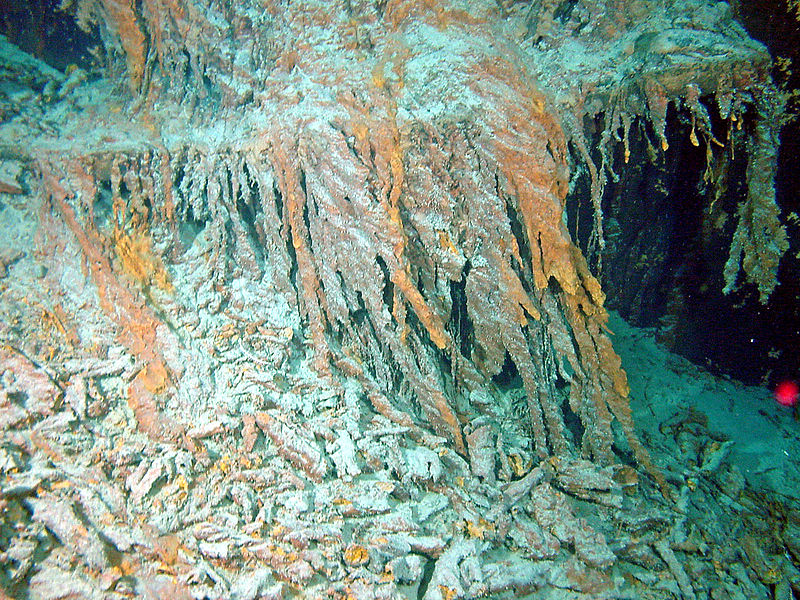
The silk comes at you in waves, brushes up against you and collectively blankets you in the pitch darkness that the light is piercing through. All manner of creature, bacteria, and rust flock to its structure. The microscopic bits of iron and rust that mighty currents of the northern seas have swept away from the craft’s walls can be viewed dancing at the windows. Their delicate clumps of bright red dissolving before your eyes.
Before long your attention turns to the figure slowly coming into focus. The most famous and most haunted of white ladies to slip beneath the grasp of man’s reach and into the  blue ocean. Where all who dare tempt for too long the fragile balance of wood, steel, and water eventually dwell. The upright bow of the Titanic bathed in light looks almost like an upscale model in the distance from the sub’s window. Like the familiar sensation of viewing a town or city from the small circular window of an airplane. You know that what you are viewing is not what perspective would have you believe it is, for it is indeed a man-made monster. Sleeping reluctantly in the depths, while the familiarity of its image makes the moment seem a bit contrived.
 Then you remember this is a tangible connection to tragedy. A link to so many lives cut short and scattered throughout the wide expanse of the sea. The wreck has become an open house for countless forms of ocean life. Nearly all of the structure’s windows and doors have been eaten away or broken off. This has created constant cross stream currents throughout the ship, exposing its many levels to sand.

The descent down from the surface must have been an incredible sight for any onlooker to witness. The wreck’s debris field bares claim to the massive unleashing of many items as the ship broke in two.  An odd mixture of large and small objects in a final battle against gravity and pressure. As it swirled and dipped slowly towards the ocean floor. Bowlers, bits of the ship’s double plated bottom, cups, mountains of coal, thousands of eggs, jars of  olives, suitcases, the ship’s impressive ice making machine, cases of champagne, the four massive smoke funnels, and the vast assortment of humanity that would remain lost for all time in the depths. 
Only a few precious hundred survived that night, even less were brought back home from the coal ships chartered to collect the dead. Those buried in graves throughout Newfoundland, hamlets across southern Ireland, and in marbled tombs in upstate New York. They were among the only ones to be reclaimed from the sea. The rest had long been consumed by the forces of nature. 
Shoes are the only items that remain today. The chemicals in their leather have preserved them from being consumed. Creating a final lasting marker for the millionaire, the fireman, the baker, and the candle stick maker who on that cold night in April were finally made equal by the great leveler of mortality. 
No one at the time of her foundering knew where she rested. Several officers and passengers who survived the actual sinking, would return in the form of ashes to the spot long believed to be the wreck’s location.  On the morning after the sinking, an eerie vapor lingered over the spot where the linear slipped below the waves. The first rescue ship saw in the distance thirteen boats, bits of cork floating everywhere, dozens of deck chairs, and only one body. This was where every single expedition undertaken to find the ship would begin their search and it was later discovered to be nearly twenty five miles from the actual location.

File:Crowd in front of White Star offices.tiff
So many avoided these waters for years. The northern shipping routes would be moved further south to prevent additional disaster. Many would often describe a feeling of dread at the most humane level, from being in the precious of such a tragic event. Today it is impossible to be there, and not feel overwhelmed. You are surrounded by water, it is inescapable, the horizon is grey blue and the wind is usually rushing at you. 
A constant chill is in the air, the sun, covered throughout most of the day by slow moving clouds the size of continents.  But, whenever it does shine through, it produces a magnificent glow. The beam of a heavenly light seems to make an effort to penetrate the depths. The lining of the water is bathed in the sunshine. A few precious feet, sometimes will mix the bright sun’s beams with the deep dark of the sea.  Never enough to reach the sand covered structure below, but, enough to make the imagination wonder.
They wreck for the first time in eighty five years was lit with giant high powered lights the week before. The salvage company’s two Russian made subs had dropped nearly five sets of these underwater production lights with ultra-long lasting batteries so that the camera crews from Discovery Channel could film the wreck live. The wreck visible in the sub’s tiny windows in the distance, the bow now diminished by the outside influences of the lights. It would be two years before their glow would finally burnt out. Until the sand could brush away the sub garbage that had been scattered by the legions of supply ships from the ocean surface, and the wreck could return to a pitch black ghost town. While the green glow of a sub light became a seldom happening once more. Tourists are no longer permitted to dive the wreck site. 
The ground just behind the structure’s broken bow section it littered with shoes. Tiny shoes that could only fit on a child, ones that were only made in the northern reaches of Sweden, and some that were standard White Star Line issue. These remaining bits of humanity are enough to turn my morality away from the childish ventures of my past. Away from any desire to see the wreck with my own eyes, or to see items removed from its halls. Only one desire now remains...
Remembrance is the act of remembering, and the ability to remember
File:Detached rusticles hires.jpg

Some very interesting facts about the Titanic

 At the time of her launch, the Royal Mail Steamer Titanic was the largest man-made moving object on Earth.

 The Titanic cost $7.5 million to build.

 The White Star Line's Titanic and her sister ship Olympic were designed to compete with the famous Cunard liners Lusitania and Mauretania.

. More than 15,000 men worked on the ship during its construction in Belfast, Northern Ireland.

 The Titanic's wake was so huge that, at its launch, it sucked in another ship and almost caused a collision.
 The Titanic featured an onboard swimming pool, a gymnasium, a squash court, and a Turkish bath and two separate libraries - one for first-class passengers, and one for second class.

 The top speed of the Titanic was 23 knots (more than 26 miles per hour).

 The Titanic originally was designed to carry 64 lifeboats. To save from cluttering decks, the ship ended up carrying 20 on her maiden voyage.

 Passenger and fashion writer Edith Rosenbaum cabled her secretary in Paris that she had "a premonition of trouble" about the Titanic. (She survived.)

Governess Elizabeth Shutes was so unnerved by the smell of the night air on April 14 that she could not fall asleep. She told fellow passengers that the smell reminded her of the air inside an ice cave she had visited. (She survived.)

 William Edward Minahan, a doctor from Fond du Lac, Wis., had his fortune read shortly before the voyage. The fortune teller predicted his death aboard the ship. She was right.

 The plot of Morgan Robertson's novel "Futility" bears an uncanny resemblance to the Titanic disaster. The novel tells the story of the Titan, the largest ship ever built, billed as "unsinkable," which strikes an iceberg in April and sinks. In the book, more than half the passengers die in the North Atlantic because of a lifeboat shortage. The book was published 14 years before the Titanic sank.


Capt. Edward G. Crosby, a Milwaukee veteran of the Civil War, founded a steamship company on Lake Michigan but became famous for refusing to put enough lifeboats for all the passengers on his steamers. Aboard the Titanic, he was unable to find a place on a lifeboat, and he sank with the ship.

Plains Georgia Tribute

President Jimmy Carter tribute video


A short tribute video i made about Plains Georgia and their favorite son Jimmy Carter. Made in honor of the new book coming out from Arcadia Publishing "Jimmy Carter In Plains The Presidential Hometown." Written by Robert Buccellato with photos from Eddie Hunter and Charles Plant.

Sunday, August 23, 2015

Jimmy Carter in plains - Boyhood home


James Earl Carter made history from the very beginning by becoming the first American President born in a hospital, the local Wise Sanatorium. His mother, Lillian, worked there as a registered nurse.  It was obvious to everyone in the small boom town of Plains that this young man was different. The Carter family was always prosperous. Their farm produced cotton, corn, watermelons, and of course, peanuts.

The Carter boyhood home, two miles west of Plains was, for years, maintained as a working farm. It was still privately owned during Carter’s Presidency. Not opened to the public, it was visible from the road and was frequently a highlight for sightseers.
The Jimmy Carter National Historic site and preservation district was established by an Act of Congress in 1987. The historic site consists of the railroad depot, shown here in the early 1980s, that had fallen into disrepair, the boyhood home, that needed to be purchased, and the Carter compound. The preservation district consists of the historic district and 650 acres of agricultural lands.


As a child, Jimmy (here kicking a football) was free to play with the African American children raised in Archery and Plains. His father, James Earl, was a successful farmer, local public official, and staunch conservative Democrat. His wife Lillian did not share his views on race and was much more liberal on Civil Rights. Many times he would leave the house when she would welcome black guests. Plains remained unchanged throughout the 1930s and 1940s. Jimmy Carter graduated from Annapolis Naval Academy and married Rosalynn Smith. Soon the young couple left Georgia to begin a promising life in the Navy. But, following the untimely death of Jimmy’s father, James Earl Carter Sr. (Pictured below with his wife Lillian), the future President surprisingly gave up his naval commission and returned home to Plains.

Like so many other areas in the country, Plains was ravaged financially by the Great Depression.  Black families were particularly affected. Some journalists in 1976 were shocked to witness the level of poverty some African American families were living under and how close their dwellings were to the potential democratic nominee’s residency. There is a mysterious pull to this tiny Hamlet in South Georgia which is hard to explain. It can only be experienced and it continues to be each year by nearly a hundred thousand tourists. They all come for different reasons and purposes. Many come with their children to hear President Carter’s Sunday school lessons, so that they can one day tell their children that they saw an American President.  Still many come with a silent longing for simpler times and to experience the rural lifestyle of Carter’s boyhood. So for these reasons and many more, Plains remains America’s hometown.

Whether you are a Carter enthusiast, a researcher, or just curious how a small town influenced a young boy who would become the president of the most powerful nation in the world, odds are you will find a visit to the Jimmy Carter National Historic Site interesting. The history and culture of this rural community can provide a look into why the Carters' ties to Plains, Georgia, have endured the stresses of public life, yet remain as strong as they were decades ago. A visit to the site provides an opportunity to explore the historic resources and rural southern culture that had an influence in molding the character and political policies of Jimmy Carter.

Lincoln's Ghost - Future Project

Harry Truman wrote from the White House, “I sit here in this old house and work on foreign affairs, read reports, and work on speeches — all the while listening to the ghosts walk up and down the hallway... The floors pop and the drapes move back and forth — I can just imagine old Andy and Teddy having an argument over Franklin…” Bess later commented, “Now about those ghosts. I'm sure they're here and I'm not half so alarmed at meeting up with any of them as I am at having to meet the live nuts I have to see every day.”
The oval office following the death of President Harding, a figure no one has yet come into contact with. 
Today I wrote the first few pages of my fourth book( three is coming out early next year, and two is coming out from Arcadia this Christmas) Lincoln's ghost. It is a complete history of the paranormal history of the presidency and the White House. It is mainly going to be a colorful take on the subjet as one can gather from the image below - the opening line of the book

Jimmy Carter in Plains book - the train depot of plains

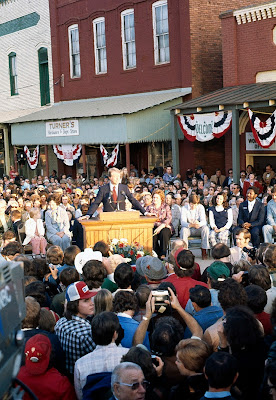
There is a historical pull to this place and it’s become manifested in the tiny green and white painted train depot at the center of town. For myself, this humble structure has always held such romantic attachment. This was where Jimmy Carter pulled it off.  Where he, along with his neighbors and family staged the most improvable and captivating Presidential campaign in history, forever changing the political landscape of the nation and how we pick our presidential nominees.


Once you enter the depot, long devoid of frequent activity, a single video can be heard echoing throughout the building. It is a video that Charles Plant put together on the 1976 election. The images are old and the voices heard are those that use to fill the television screens in countless homes decades earlier. The nightly news anchors of the past; Cronkite, Harry Reasoner, and John Chancellor, can be heard.  The desired effect is easily achieved, transporting visitors back to a time when this depot was packed with locals and campaign workers and primary nights would turn into local vigils and tailgate festivals, as several TVs were installed to witness the results of so many past contests, when their favorite son was trying to achieve the impossible. 


. Two rocking chairs, used frequently by America’s First Mother, Lillian Carter, can still be seen.  Today, a sign proudly and humorously recounts the fact that “Behind this closed door” is the reason why the depot was selected as the campaign headquarters. It was the location of the only available public bathroom in town. Today the bathroom is closed and visitors are prevented from entering this historic lavatory. 
As the election of Jimmy Carter became a real possibility, both the candidate and his hometown started becoming big business. Carter’s wide smile began showing up everywhere in town and souvenir makers had a field day turning the town into a household name nationwide. Some, like the N.G. Slater campaign buttons were of high quality, while others were simply made by an endless series of small entrepreneurs looking for an easy buck. Eventually, the massive level of outside guests began to die down. After the Carter Presidency entered the history books, the town and its famous son both shared in parallel struggles to acclimate themselves to life outside the national spotlight. Plains and Carter both took it upon themselves to help preserve the best elements of the 1976 election and its aftermath for posterity. It was not an easy task for them both. But, President Carter threw himself into the task of turning key structures of his hometown into a national park. With the aid of the residents and outside support, the former president succeeded beyond his wildest hopes. 

The town’s train depot was constructed in 1888 and was, for a time, the only building with a public bathroom. This was the primary reason for its selection as the hometown headquarters for the Carter Presidential campaign. It was the site of numerous hometown primary parties and was where candidate Carter would hold interviews whenever in town.  As the 1970s dawned, Plains remained largely unchanged. But, following his announcement for president, the entire landscape of the community began to change. The primary night parties would begin at the depot and quickly took on a church potluck atmosphere. There were said to have been rows of flatbed trucks everywhere and tiny campers. 

This commemorative T-shirt, owned by Plains resident and Peanut Brigader Ida English. This shirt and other souvenirs were proudly displayed by Jimmy Carter’s supporters to celebrate his victory in the 1976 presidential election. This style of shirt was worn by Peanut Brigaders on the night of Jimmy Carter's Presidential election. It was the idea of Maxime Reese to have these t shirts made and it wasn't until Jimmy Carter won late in the early morning that those on the platform reveled the t shirts. Miss Lillian raised her tired self from her rocking chair on the Platform to reveal her shirt and suddenly fell down. Laughing she soon recovered and the crowd went wild.

The Town in a short period of time had gone from a sleepy community of 600 people into the capital of American political life. While the nation's major cities were spending millions each year to attract new residences to their communities. The town of Plains was getting up to 10 thousand tourists a day and hadn't spend a dime. But, of-course all of that was soon to change.


The inside of the train depot museum during the 1980s. Following 1979 the crowds in Plains began to die down and once Carter lost re-election the community began to turn sleepy once again. There was till tourists, but never like the glory days. Before the National Park Service became actively involved in preserving the town, the depot served as the town’s visitor center. Today it has interactive exhibits and detailed accounts of the 1976 election. But, when this picture was taken, the citizens of Plains relied almost solely on their own personal memorabilia to fill the museum. 
The Jimmy Carter National Historic site and preservation district was established by an Act of Congress in 1987. The historic site consists of the railroad depot, shown here in the early 1980s, that had fallen into disrepair, the boyhood home, that needed to be purchased, and the Carter compound. The preservation district consists of the historic district and 650 acres of agricultural lands.  


The Depot Museum was designed to retain all the humble charms of its 1970's structure and to also host a grouping of anecdotes from the 1976 election.  In the beginning the town could only depend on the relics they themselves still had in their homes and in shops on Main Street. But, then Carter Presidential Collectors began to make very generous donations to the site and the place became one of the most appealing parts of the historic district. 

Jimmy Carter In Plains Book Cover


Here it is the cover to the new book on plains Georgia and its favorite son
Out this Christmas.
For many, the physical connections to our presidents have become unreachable; deeply rooted in the past and foreign to us. We can no longer see Washington’s birthplace or William Henry Harrison’s log cabin. Plains, Georgia is different, and the attachment Americans have for it remains truly unique. The book Jimmy Carter in Plains: A Presidential Hometown tells the inspirational story of how one man and his community transformed a nation.
When Jimmy Carter, a one term Governor of Georgia announced his candidacy for President, no one took him seriously. He was publicly nicknamed “Jimmy Who.” Yet, in just two years, he managed to pull off the most spectacular and unprecedented victory in American Political history, winning primary after primary thanks to his effective personal form of politicking and the support of his hometown. Many of his own neighbors campaigned for him in several states, and became the “Peanut Brigade.”
As Carter’s fame grew so did the crowds that started to flock into the tiny sleepy hamlet of Plains, Georgia, making celebrities out of the candidate’s mother, younger brother, and daughter. The exceptional photos of Charles W. Plant guide the reader along the historic moments of the 1976 bicentennial election that made Plains, Georgia America’s Hometown.


It was often proclaimed throughout the 1976 election that “The strength of one man can be measured by the path he takes to travel there.” In the life of our nation’s 39th president, all roads, no matter how elevated, seem connected to one small hamlet in Southern Georgia. No town has ever been so rooted in the life and success of a president.